
13 May 2026
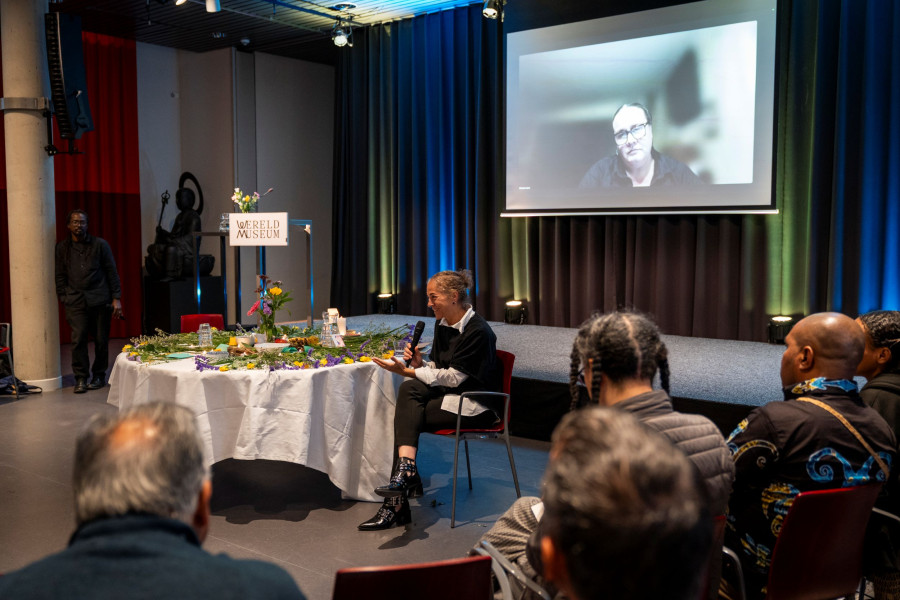
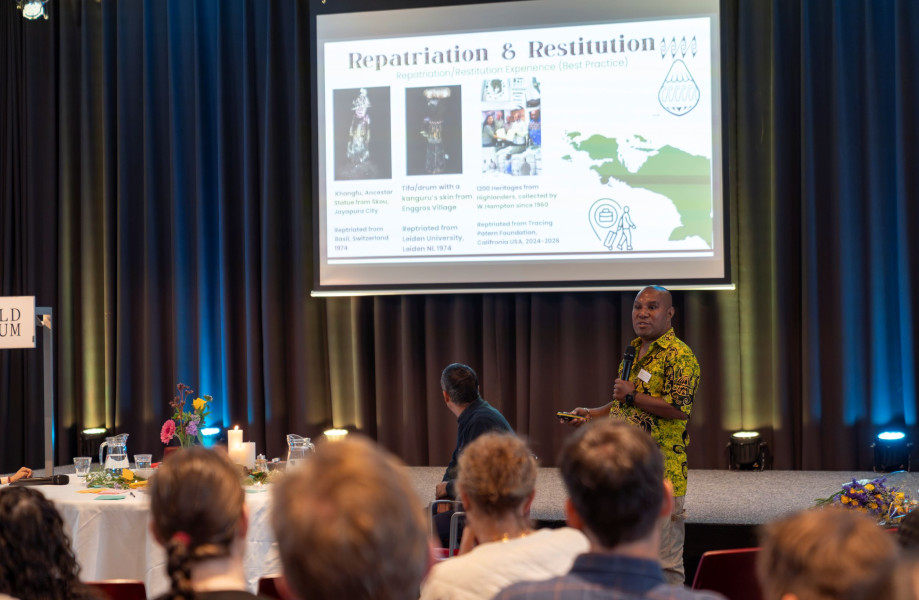
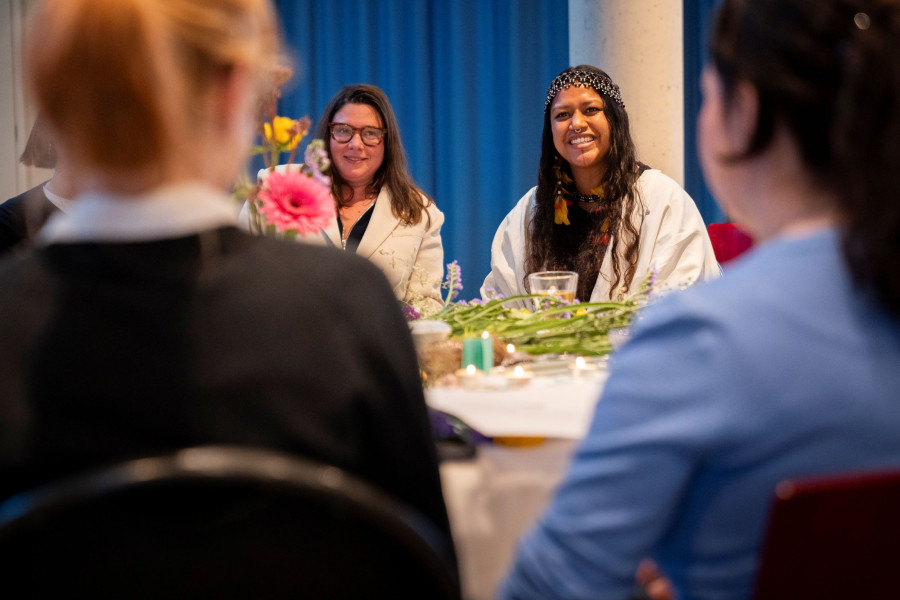
Together with members of the Colonial Collections Consortium, Wereldmuseum Leiden and RCMC are organising an international workshop to contribute to a policy framework on the repatriation/rematriation and handling of ancestral remains in the Netherlands. How might a policy look when we foreground the lived realities and voices of those past and presence whose lives were most affected by colonial and post-colonial practices of collecting, researching displaying human and ancestral remains in museums and other heritage institutions? Should ancestral remains “acquired” under colonial situations be researched or exhibited within museums today? And how might policies embed Indigenous struggles for self-determination and sovereignty in their framework?
Registration has now closed. Please contact the RCMC to discuss the possibility to attend: rcmc@wereldmuseum.nl
| 9:30 | Registration with coffee and tea |
| 10:00 | Honoring ceremony Opening words by Wayne Modest |
| 10:45 | Listening and Conversations: Marie-Josée Artist |
| 12:15 | Lunch in the Museum Café |
| 13:15 | Listening and Conversations: Lucía Watson Jiménez |
| 14:45 | Coffee break |
| 15:15 | Listening and Conversations: Bambang Purwanto |
| 16:45 | Cloncluding remarks by Wayne Modest Honoring ceremony |
| 17:30 | Drinks in the Museum Café and garden |
| 18:00 | Buffet dinner in the Museum Café and garden |
| 20:00 | End dinner |
| 9:30 | Registration with coffee and tea |
| 10:00 | Honoring ceremony Opening words by Wayne Modest |
| 10:15 | Listening and Conversations: Amber Aranui (joins online) |
| 11:30 | Coffee break |
| 11:45 | Break out sessions:
|
| 12:30 | Plenary recap of the break out sessions |
| 13:00 | Lunch at the Museum Café |
| 14:00 | Listening and Conversations: Elizabeth DiGangi |
| 15:30 | Coffee break |
| 16:00 | Panel discussion on diaspora with Jeremy Flohr, Nancy Jouwe, Menucha Latumaerissa & Manuwi C. Tokai |
| 16:30 | Concluding remarks Honoring ceremony |
Amber Aranui is a curator at the Museum of New Zealand Te Papa Tongarewa, where she has worked since 2008. Her role at the museum began as the provenance researcher for the Karanga Aotearoa Repatriation Programme where she remained for 12 years. In 2021, Aranui moved into the Mātaranga Māori curatorial team at Te Papa where her repatriation work continues to develop along with her other interests in the history of Aotearoa and our connection to the wider Pacific, utilizing her background in Anthropology (BA) and Archaeology (MA). She received her PhD in Māori Studies which focused on the repatriation of Māori ancestral remains. More recently Aranui has focused on projects where she is able to work directly with her iwi Ngāti Kahungunu.
Marie-Josée Artist is an adviser to VIDS and an independent consultant. As a community development specialist with VIDS, she has over 20 years of experience working with Indigenous Peoples and local communities in Suriname. In her advisory role, she currently supports VIDS from an Indigenous worldview in dialogue, policy, and strategic processes related to the Dutch history of colonization and slavery, decolonization, and museum-based initiatives.
Elizabeth DiGangi earned her PhD in biological anthropology from the University of Tennessee and she is currently an Associate Professor of Anthropology at Binghamton University in upstate New York, United States. She is a board-certified forensic anthropologist and her research interests broadly fit under the umbrella of social justice and human rights. Among other things, she has worked to return the remains of Indigenous children to families and she has served as an expert witness on behalf of unaccompanied minors to the United States. Recently, two critical scholarly pieces co-authored with a colleague served to reignite a long-simmering debate about race estimation in forensic anthropology. She is currently working on a book about how racism is embedded in the practice of biological anthropology.
Muriel Fernandes has been the Chair of the Association of Indigenous Village Leaders in Suriname (VIDS) since 2022 and is a traditional leader of the Lokono community of Casipora. As the first woman to chair VIDS, she provides strong gender-responsive leadership, actively advancing Indigenous women’s leadership alongside the legal recognition of Indigenous Peoples’ collective rights -particularly land rights, self-determination, and Free, Prior and Informed Consent (FPIC)- while strengthening Indigenous governance and cultural heritage.
Jeremy Flohr is co-founder of Beyond Walls and works as a filmmaker and visual storyteller. Whether he produces film portraits, poetry films or documentaries, his work is at the intersection of colonial history, personal stories and social themes. Intrigued by inspiring people and personal stories of marginalized groups; with his sensitive feel for storytelling and unique eye as a filmmaker, Flohr keeps uncovering stories the world needs to know, needs to hear, or better yet, needs to see.
Nancy Jouwe has been actively involved in both academic and social spheres, focusing on women's rights, the history of slavery, transcultural exchange, and heritage in a postcolonial context. Among other things, she was director of the Stichting Papua Cultureel Erfgoed (PACE) and artistic director at Kosmopolis Utrecht. Over the past decades, she has held administrative positions in various organizations and has taught at, among others, the Utrecht School of the Arts, where she has held a fellowship since 2022 in connection with research into the history of slavery in the city of Utrecht. Currently, Jouwe works on a PhD on Papuans becoming a diaspora.
Harold Kelly is an archaeologist at the National Archaeological Museum of Aruba, where he has worked since 2003 and currently serves as interim director. He holds a master’s degree from Leiden University, with research focused on Indigenous coral tools from Guadeloupe. His work centers on the archaeology of Aruba, including rock art, early migrations, and environmental adaptation. Kelly has co-authored several publications on Caribbean archaeology and extreme wave events in the ABC islands. His current research explores how past communities responded to climatic and resource challenges, combining archaeological data with traditional knowledge practices to better understand resilience in island environments.
Enrico Yory Kondologit is a curator at the Loka Budaya Museum of Cendrawasih University, Jayapura (West-Papua). Kondologit is also a Lecturer and Researcher of Anthropology at the Universitas Cendrawasih, where he was trained as an anthropologist. Besides, he is also involved at the Indonesian Museum Association of Papua as the Secretary.
Menucha Latumaerissa is the chair of the Moluccan-Dutch foundation Budaya Kita and works as an indpendent researcher. He was actively involved in the reparatriation of Moluccan skulls from the Museum Vrolik to Tanimbar.
Anne May Olli has expertise in Sámi cultural heritage and object conservation, and has a Northern Sámi background. Olli holds a master in Conservation from the University of Oslo (2013), focusing on pesticides in Sami museum collections. She is the director at the largest Sámi museum in Norway, RiddoDuottarMuseat (RDM), that consists of 5 local museums in the western part of Finnmark in Northern Norway. The administration in located in Karasjok. Olli has worked as a Conservator at one of the local museums in RDM for many years, with emphasis on documentation of traditional Sámi technology and its use in conservation. She is also a farmer (milk-production) and her husband is a reindeer pastoralist.
María Patricia Ordóñez is an Ecuadorian archaeologist. She holds a PhD and MA in Archaeology (2014) from Universiteit Leiden (The Netherlands). She also holds a Master's degree in Forensic Anthropology and Archaeology from Cranfield University (England). Currently she teaches at Universidad San Francisco de Quito (Ecuador) in the Anthropology Department. Previously she served as Director of Research and Innovation at the National Institute of Cultural Heritage (Ecuador) and curator of the Casa del Alabado Museum (Ecuador) as well as a consultant in heritage and archaeology projects, as guest curator at the Museo Nacional del Ecuador (MUNA), the Museo Jacinto Jijón y Caamaño (Ecuador) and as researcher at Wereldmuseum Leiden. Her work focuses on the formation and use of collections of human remains in the Andean area and Western Europe.
Bambang Purwanto is a professor in History at Universitas Gadjah Mada Yogyakarta Indonesia. He graduated from School of Oriental and African Studies (SOAS) University of London UK, where he received his MA in 1989 and PhD in 1992. His main interest is in economic history, social history, daily life history, and Indonesian historiography. He is now part of Indonesian-Dutch research group working on “Exploring New Futures for Indonesian Objects: Dismantling Colonial Knowledge Production and Recovering Lost Histories and Memories”, a project funded by the Dutch Research Council (NWA).
Ciraj Rassool is Senior Professor in the Department of Historical Studies at the University of the Western Cape in South Africa, and director of the African Programme in Museum and Heritage Studies. He has published widely on changing old museums & making new museums, race in museums, restitution, political movements and the politics of nonracialism. He served on the boards of the District Six Museum and Iziko Museums of South Africa (and also served as Chairperson for a term of both), and is a member of the South African National Advisory Board for Restitution and Repatriation. Rassool was a principal investigator on the international research projects, Action for Restitution to Africa, and Reconnecting ‘Objects’: Epistemic Plurality and Transformative Practices in and beyond Museums, and a Critical Friend of Pressing Matter. He is a co-investigator of the Canadian-based international project, Thinking Through the Museum.
Motsane G. Seabela is an interdisciplinary researcher and museologist focused on critical heritage and museum studies, as well as indigenous epistemologies. She currently is the Curator of Anthropology at the DITSONG National Museum of Cultural History, Pretoria, South Africa. Seabela is also a postdoctoral fellow at the University of Pretoria and holds a PhD from the same University. Her research centres on the overlooked narratives of black individuals in museums and ‘collections’ that are deeply rooted in colonial histories. One of her recent creative works is the co-curated exhibition entitled Inherited Obsessions, which interrogates the concepts of preservation and its true purpose. Additionally, Seabela addresses the transformation of museums from sites of violence to spaces of healing through restitution efforts both within and beyond their walls.
Richard Shing is the director of the Vanuatu Cultural Centre. With a background in archaeology, Shing oversees the work of the Vanuatu Kaljoral Senta (VKS), a statutory body that is mandated to preserve, protect and develop important aspects of Vanuatu’s rich and diverse cultural heritage. VKS plays a major role in the recording and documentation of cultural and historical events and oral traditions, the collection of valuable oral traditions and traditional knowledge and artefacts, the surveying of cultural and historical sites and the discovery of significant archaeological sites.
Deborah A. Thomas is the R. Jean Brownlee Professor of Anthropology, and the Director of the Center for Experimental Ethnography at the University of Pennsylvania. She is the author of Exorbitance: A Speculative Ethnography of Evidence, Political Life in the Wake of the Plantation: Sovereignty, Witnessing, Repair, Exceptional Violence: Embodied Citizenship in Transnational Jamaica and Modern Blackness: Nationalism, Globalization, and the Politics of Culture in Jamaica. Thomas co-directed the documentary films Bad Friday and Four Days in May, and she is the co-curator of a multi-media installation titled Bearing Witness: Four Days in West Kingston. She is the recipient of several awards, including a Guggenheim fellowship, and she is an elected member of the American Academy of Arts and Sciences. Prior to her life in the academy, she was a professional dancer with the New York-based Urban Bush Women.
Manuwi C Tokai is a singer from the Kalinya Terewuyu Nation from the Amazone, Akarani. She grew up in The Netherlands. Her work is influenced by the songs that she learned from the elders from the Terewuyu community. Her work is deeply related to the work that she does as a human rights activist. She is a community builder and has been organising actions like the 2020 Black Life Matters protest in Amsterdam and Rotterdam. She facilitated many conversations for the emancipation of Black, Indigenous and People of Color. Tokai is currently also working on archiving the Kalinya Terewuyu language’s true songs and is advocating for the preservation of Indigenous languages and culture.
Rachel Watkins is Associate Professor of Anthropology at the University of Pennsylvania. As a black feminist, biocultural anthropologist, her scholarship addresses biological and social histories of African-Americans, the social relations of scientific knowledge, production, and black feminist critiques of Western scientific practices. She is also the Curator of the Biological Anthropology Section at the Penn Museum, where she oversees stewardship, research, teaching and engagement regarding the human remains in their care. This includes building cross-institutional, international networks of scholars, legal experts, and descendant community partners to collectively engage in this work. Watkins’ scholar-activist formation is grounded in teaching, learning and research experiences with ancestral remains in the W. Montague Cobb Human Skeletal Collection at Howard University, and those unearthed from the Lower Manhattan New York African Burial Ground. Both shaped her commitments to ethical research practice, descendant community engagement, and the study of African descendant remains in diasporic context in her research and consulting work.
Lucía Watson Jiménez is a Peruvian archaeologist specializing in human remains and Andean mummies. She holds a PhD in Anthropology from UNAM and completed postdoctoral training in Andean Studies in Peru and Non-European Archaeology in Poland. She is co-director of “Momias como Microcosmos” with Dr. Andrew Nelson, applying digital X-rays and CT scanning to funerary bundles from Peru’s central coast. She is a bioarcheologist researcher at University of Wrocław analyzing pre-Hispanic human remains from southern Peru. Consultant to Peru’s Ministries of Foreign Affairs and Culture on human remains and Andean mummies, volunteer advisor to ICOM, forensic delegate for ICRC.
Ancestral remains collected within the colonial context can be found across numerous, very different institutions and collections in the Netherlands. These span cultural, historical and academic collections. Like the museum group Wereldmuseum, and especially the Tropenmuseum, some of these institutions have a history in physical anthropology, and include objects acquired in the service of racial science. Indeed, large collections of human and ancestral remains, for example in medical or anatomical, or broader natural history collections, such as those in the Museum Vrolik, Groningen University Museum or the Anatomical Museum in Leiden, also include ancestral remains collected within a colonial context. These collections were brought together as part of a study in human variation, including variations in what was considered as the normal body, or to prove racialized difference.
Within the Wereldmuseum, ancestral remains were also acquired as part of a tradition of cultural anthropology – in, for example the study of rituals related to death or healing. In some instances, questions of aesthetics played a role in how ancestral remains collections were developed, such as remains acquired privately by artists or art collectors or within, for example, the study of the anthropology of art (Wereldmuseum), or the aesthetics of science (Groningen University Museum or Utrecht University Museum). While predominantly comprised of skeletal material, these collections also include skin, hair, teeth and nail samples.
Within the shifting global context of restitutionary practices, ancestral remains have come to occupy a special space of concern across the museum profession, among academics, and importantly, among representatives of different communities who share relations with these ancestors. Within the framework of restitution of objects collected within a colonial context, ancestral remains present similar complications to other objects, for example in terms of their precise provenance, or the complexity of the historical conditions through which they entered museums. Like other objects, ancestral remains were gifted, traded through established dealers, acquired during conditions of war, but also stolen. And yet, they also present more complex challenges.
On the one hand, questions may arise as to whether ancestral remains can/should be regarded as museological objects and therefore can be owned by museums in the first place. Are human and ancestral remains “objects”? It could also be asked, how do we deal with the differing ways of assigning value to this category of object that would make them either scientific, cultural, or ancestral, whether these are mutually exclusive categories, and how might these different categories impact decisions about return? Indeed, as a category of “object”, does it matter how they were collected, for example, through scientific expeditions or in hospitals after the patient died? Were they collected as part of medical explorations or to prove specific, now discredited, racial ideas? Does it make a difference? Can we conceive of ethico-legal frameworks beyond return that could allow ancestral remains to be cared for, researched, or displayed, for example, when done together with descendant communities, as part of a scientific or educative agenda, that still honor ancestral rights and dignity? Said differently, is return the only option for repair?
Arguably, a more mundane question to ask is how to define human and ancestral remains, and what are the limits of what fits in or outside of this category? Are all human remains ancestral? Should all categories of ancestral remains be treated in the same way – is the category hair or nail similar to skin or even skeletal remains? How might the different intellectual histories, or the historical function for which remains were used impact on how we treat with them in the present? Or do we also include photographs, or facial mask taking in the process of physical anthropology?
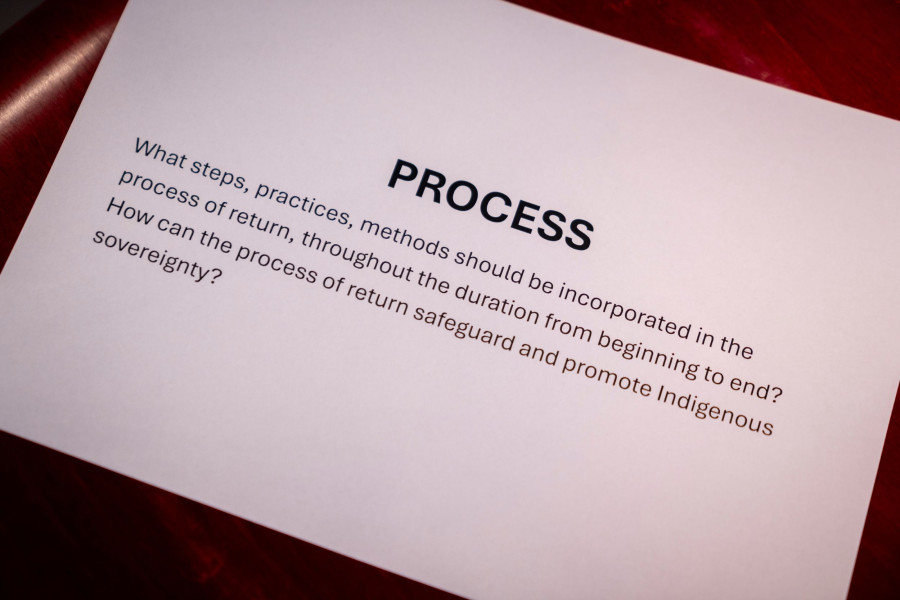
Since 2021 there is an active policy on the restitution of colonial objects in place in the Netherlands. When this policy framework was developed, it was recommended there needed to be a separate policy on ancestral remains. The main goal of this workshop is therefore to shape this future policy. Because of the way in which ancestral remains entered museum collections, developing a national policy framework necessitates centering the perspectives of Indigenous and formerly colonized people. With this workshop, we aim to bring some of the most cutting-edge theory and policy input on this theme together, to understand current policy frameworks in other localities and contemporary (institutional) restitution practices to develop a more comprehensive national policy shaped by Indigenous people from across the world.
We are committed to making this event accessible to everyone. If you require specific accommodations to participate fully, please reach out to us at rcmc@wereldmuseum.nl by 1 May or indicate your needs on the registration form.
There are two quiet spaces which can be used by workshop attendees to take a break at any point. Directly opposite the conference room on the first floor, the Buddha Room offers a tranquil space. On the ground floor, at the end of the museum café, the Museum Lounge can be used to take a break. We cannot guarantee complete silence due to other visitors in the museum.